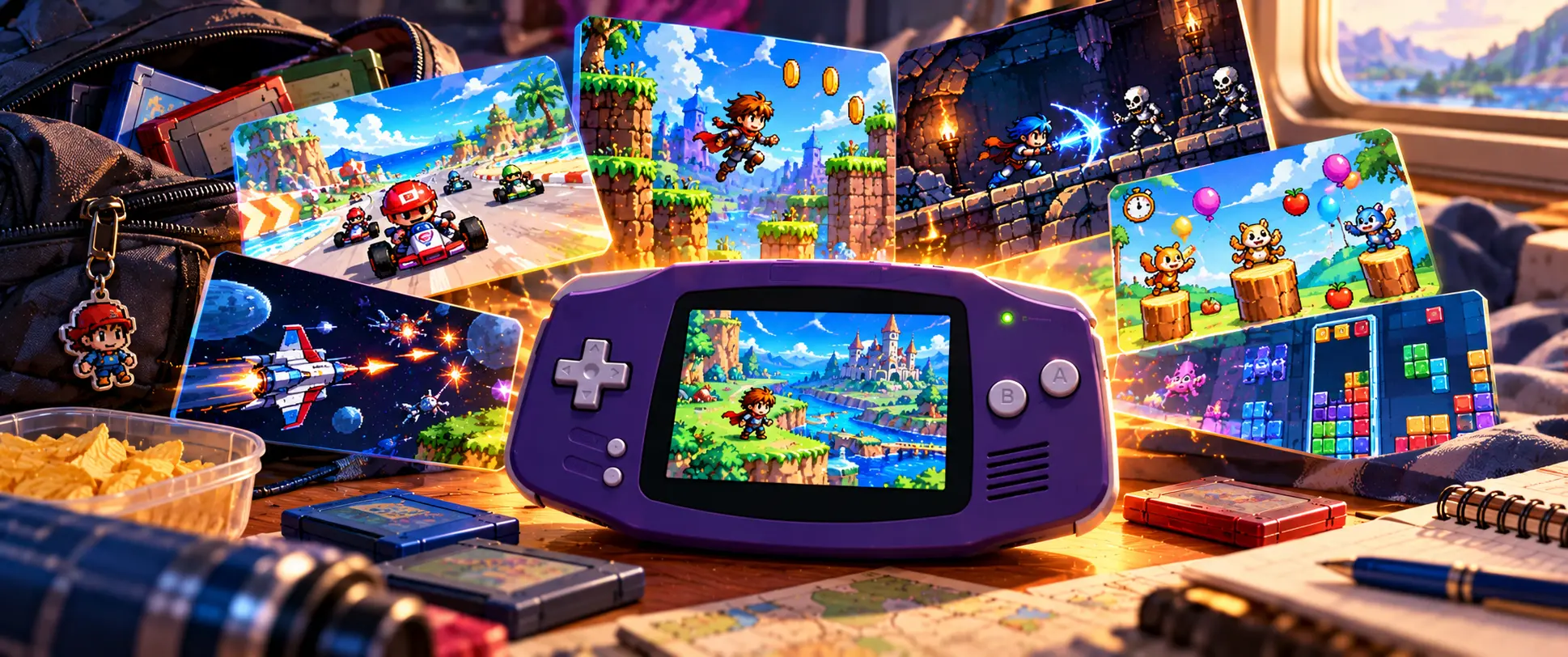
GBA games for short sessions work well because portable titles often provide clear objectives, quick gameplay loops, convenient stopping points, and progress that feels meaningful even when players have limited time. Racing games, platformers, puzzle titles, action games, and collections of microgames can all deliver satisfying experiences without requiring a long uninterrupted session.
This flexibility is one of the major strengths of handheld gaming. A game can offer a larger adventure while still giving players useful things to accomplish in smaller periods of play.
Why GBA Games for Short Sessions Feel So Natural
Portable GBA games for short sessions how people approach play.
A home-console game may be played when someone expects to remain in front of a television for a while. A handheld can fit more easily into shorter breaks or moments of free time.
The best short-session experiences respect that flexibility.
Players can start the game, understand what they need to accomplish, make progress, and stop at a sensible point. They do not need to spend most of the available time remembering complicated systems or waiting to reach the next meaningful objective.
This design makes returning to a game easier as well.
Clear Goals Make Quick Play More Satisfying
Short sessions work best when players can identify an immediate objective.
A racing game provides an obvious example. Choose a course, complete a race, and receive a result. The entire activity has a natural beginning and ending.
Platformers can use levels in a similar way. Completing one stage provides a clear sense of progress even if the larger game contains many more areas.
Puzzle games, challenge modes, and certain action titles can also divide gameplay into manageable objectives.
These structures matter because a short session should still feel complete. Players are more likely to return when even a small amount of time produces a recognizable accomplishment.
WarioWare Shows the Appeal of Bite-Sized Gameplay
WarioWare demonstrates how far short-session design can go.
Its rapid microgames reduce challenges to brief interactions that players must understand and complete quickly. The pace creates constant variety without requiring a lengthy setup before the action begins.
This format works naturally on a handheld.
A player can experience several different challenges within a short period, making the game suitable for situations where there is not enough time to begin a larger adventure.
However, short gameplay does not mean shallow gameplay. Fast challenges can still test timing, recognition, reactions, and adaptability.
The key is that the experience delivers its entertainment quickly.
Racing Games Have Natural Stopping Points
Racing is another genre that adapts well to short sessions.
Mario Kart: Super Circuit allows gameplay to be divided naturally around individual races and competitions. A player does not necessarily need to commit to a long adventure before reaching something enjoyable.
Racing games also provide repeatable goals.
Players can improve their performance, learn courses, experiment with different approaches, or simply replay a favorite track.
That combination of quick access and replayability is particularly valuable for portable gaming.
Players looking across genres for fun Game Boy Advance games can consider session length alongside gameplay style, difficulty, replay value, and personal genre preferences.
Save Systems Matter for Portable Gaming
A good portable game does not always need to be designed around extremely short levels. Longer adventures can also work in limited sessions when saving and progression are handled effectively.
The important question is whether players can stop without losing substantial progress.
Games with convenient save opportunities or frequent natural stopping points make this easier. Players can explore, complete a battle, finish a stage, reach a new location, or accomplish another objective before ending the session.
Poor stopping options create the opposite experience.
If players must continue much longer than expected before they can safely stop, the game becomes less convenient for spontaneous handheld play.
Therefore, save design can strongly influence how well a larger game fits portable use.
Short Sessions Can Still Support Long Adventures
Role-playing and adventure games show that quick sessions and large games are not opposites.
A player does not need to finish an entire dungeon, story chapter, or major objective every time the system is turned on.
Instead, progress can happen incrementally.
One session might involve a few battles. Another might focus on exploration, equipment, collecting items, or developing a character or team.
Over many sessions, these small achievements contribute to a much larger adventure.
This is one reason handheld RPGs can work despite their length. Their overall experience may be substantial, while individual actions remain manageable.
Simple Controls Help Players Return Quickly
Games designed for shorter sessions benefit from controls that are easy to remember.
This does not mean the mechanics must lack depth.
A game can have simple inputs while creating increasingly difficult situations around them. Platformers often demonstrate this by using a small set of movement abilities in progressively more challenging environments.
When players return after a break, familiar controls reduce the time needed to become comfortable again.
That matters for handheld games because play can be more fragmented. Someone may play several sessions in one day and then leave the game untouched for a week.
Clear controls make both situations easier.
Replayability Makes Quick Games Last Longer
Short games can still provide considerable long-term value when their mechanics encourage repeated play.
A racing game may invite players to improve results. A platformer can include collectibles or optional challenges. A puzzle game can offer increasingly difficult problems.
Microgames can remain enjoyable because their rapid structure encourages players to improve reactions and performance.
This type of replayability differs from simply making a game longer.
Instead of adding unnecessary content, the game gives players reasons to enjoy familiar mechanics again.
For portable gaming, that approach can be especially effective because a repeated challenge fits easily into another short session.
Are Short-Session Games Only for Casual Players?
No. Session length and difficulty are separate characteristics.
A game can be easy to play for ten minutes while still demanding considerable skill.
Difficult platforming sections, tactical challenges, competitive races, or score-based gameplay can all fit into short periods.
Experienced players may actually appreciate this structure because it lets them practice a specific challenge without committing to a lengthy session.
Likewise, beginners can benefit from clear objectives and manageable chunks of gameplay.
Short-session design is therefore about flexibility rather than a particular skill level.
Why Short-Session Design Suits Handheld Gaming
Handheld gaming works best when players can adapt the experience to the time available.
Sometimes that means playing for an extended period. At other times, it means completing one race, one stage, a few microgames, or a small part of a larger adventure.
The Game Boy Advance library supported both approaches through racing, platforming, action, puzzle, RPG, and other genres.
Ultimately, GBA games for short sessions remain appealing because they can provide meaningful entertainment without demanding a fixed amount of time. Clear objectives, sensible stopping points, accessible controls, replayable mechanics, and practical save systems allow portable games to fit naturally around the player rather than forcing the player to organize their time around the game.