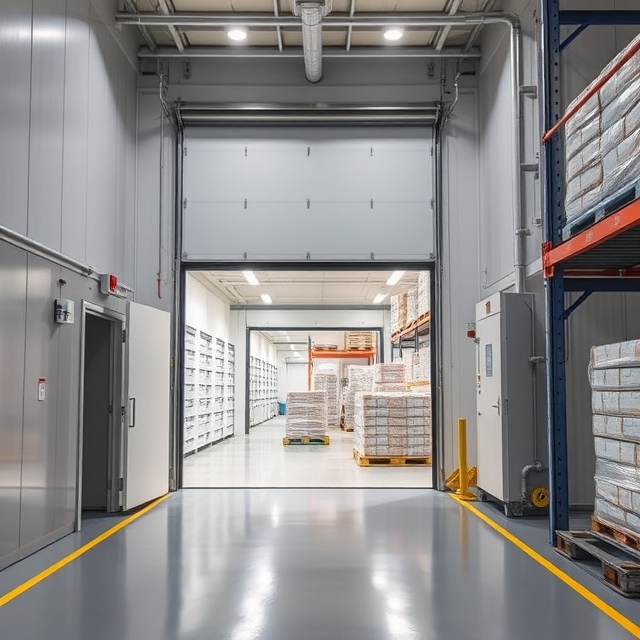
Pharmaceutical cold storage requirements extend beyond refrigeration equipment. The doorway itself can affect how effectively a temperature-controlled room separates its internal environment from surrounding areas. A suitable door should support thermal separation, controlled access, cleanability, safe operation, and the movement of temperature-sensitive products.
This is particularly important in pharmaceutical warehouses, distribution centers, cold rooms, freezer rooms, and other facilities where products must remain within specified storage conditions. Storage requirements vary by product, so the door system should be selected according to the actual operating environment rather than using one configuration for every application.
Why Door Design Matters in Pharmaceutical Storage
Every time a cold-storage door opens, air can move between the controlled room and the surrounding space. The effect depends on factors such as the temperature difference, opening duration, traffic frequency, room design, and sealing performance.
WHO guidance for pharmaceutical storage recognizes door openings and air infiltration as factors that can affect temperature control in temperature-controlled storage areas.
For that reason, a pharmaceutical cold-storage doorway should be considered part of the facility’s environmental-control system.
The main requirements generally involve:
- Thermal insulation
- Effective perimeter sealing
- Appropriate opening and closing operation
- Suitable access control
- Cleanable construction
- Safe personnel and material movement
- Appropriate maintenance access
- Compatibility with the room’s temperature and humidity conditions
Insulation and Sealing Are Core Requirements
A cold-storage door needs to provide an effective barrier between different environments. Insulated panels can reduce heat transfer through the door, while perimeter seals help limit unwanted air movement around the closed panel.
However, insulation alone does not determine the performance of the complete doorway.
Frames, joints, thresholds, gaskets, and installation details also deserve attention. A well-insulated panel can still perform poorly if significant gaps exist around its perimeter or if seals become damaged.
Facilities should therefore inspect the complete assembly rather than evaluating the door panel in isolation.
Door Opening Frequency Should Match the Operation
A pharmaceutical storage room with occasional personnel access has different requirements from a distribution area where pallets enter and leave throughout the day.
High-traffic openings may benefit from a door configuration designed for frequent cycles and efficient movement. In some applications, automated or high-speed operation can reduce the amount of time the opening remains exposed to the surrounding environment.
The selection should consider:
- Number of daily door cycles
- Forklift or pallet-truck traffic
- Personnel movement
- Opening dimensions
- Required operating speed
- Safety sensors
- Available space
- Temperature difference between adjacent areas
The objective is not simply to choose the fastest door. The operating method should fit the facility’s traffic, safety, and temperature-control requirements.
Access Control Can Be Important
Some pharmaceutical storage areas contain products that require restricted access. In these situations, the door may need to work alongside the facility’s access-control system.
Depending on the application, this can include controlled entry, electronic identification, monitoring, or other security measures.
However, security should not compromise safe operation. Where access control is installed, the facility should ensure that authorized personnel can use the door safely and that emergency-opening provisions are appropriate to the room and applicable requirements.
Cleanability and Hygiene Should Be Considered
Pharmaceutical storage areas require controlled housekeeping and maintenance practices. The door should therefore be compatible with the cleaning procedures used in the facility.
Smooth and durable surfaces can make inspection and cleaning more practical. Door frames, seals, tracks, handles, and other components should also be considered because difficult-to-access areas can make routine maintenance more complicated.
The surrounding floor and threshold should receive attention as well. Pharmaceutical cold-chain guidance emphasizes maintaining clean temperature-controlled areas and preventing the accumulation of dirt, waste, frost, and ice.
Choose the Door Around the Temperature Environment
Not every pharmaceutical product requires the same storage environment. Some products may require refrigerated conditions, while others require frozen or otherwise controlled environments.
The door specification should therefore begin with the room’s actual operating conditions.
Consider:
Refrigerated Rooms
These rooms require a door that supports separation between the controlled-temperature area and adjacent spaces. Insulation and sealing become particularly relevant where the doorway experiences frequent access.
Freezer Rooms
Freezer environments introduce additional concerns such as frost, condensation, and ice formation. Door seals, thermal performance, opening frequency, and maintenance should be considered together.
Temperature-Controlled Warehouses
Larger warehouses may have multiple temperature zones and substantial product movement. In these areas, door dimensions, traffic flow, automation, and access management can become as important as insulation.
Temperature-Controlled Access Doors Should Be Selected as a System
When reviewing temperature-controlled access doors, facility teams should evaluate the entire access system rather than focusing on one specification.
The door panel, frame, seals, operating mechanism, safety equipment, and installation all contribute to how the doorway functions.
For example, a high-traffic pharmaceutical distribution area may require a different configuration from a small cold room that is opened only several times a day. Likewise, a freezer doorway may require different considerations from a chilled storage room because frost and condensation can become more significant.
Monitoring Does Not Replace Good Door Design
Temperature monitoring is essential for identifying excursions and demonstrating that required storage conditions are being maintained. Guidance for temperature-sensitive pharmaceutical products recommends monitoring systems that account for areas where temperature variation is most likely to occur, including the effects of door opening.
However, monitoring should not be treated as a substitute for appropriate facility design.
A good approach combines:
- Suitable refrigeration capacity
- Appropriate room insulation
- A properly specified door
- Effective door sealing
- Controlled operating procedures
- Temperature monitoring
- Preventive maintenance
Together, these measures create a more complete temperature-control strategy.
Common Questions About Pharmaceutical Storage Doors
What should a pharmaceutical cold-storage door provide?
It should provide suitable thermal separation, sealing, safe access, cleanability, and reliable operation for the specific storage environment. The exact specification depends on temperature, traffic, room design, and facility procedures.
Are high-speed doors necessary for pharmaceutical cold rooms?
Not necessarily. High-speed operation may be appropriate for frequently used openings, but lower-traffic rooms may require a different configuration. The decision should be based on actual operating conditions.
Why are door seals important?
Door seals help reduce uncontrolled air movement around the closed doorway. Damaged or poorly fitted seals can reduce the effectiveness of the thermal barrier and may contribute to condensation or frost problems in some environments.
Should pharmaceutical cold-storage doors have access control?
Where the facility requires restricted entry, the door can be integrated with an appropriate access-control system. The arrangement should still allow safe operation and emergency access where required.
How often should pharmaceutical cold-storage doors be inspected?
Inspection frequency should follow the facility’s preventive-maintenance procedures and operating conditions. High-traffic doors may require closer attention to seals, tracks, sensors, alignment, and other moving components.
A pharmaceutical cold-storage door is more than a physical barrier between two rooms. It forms part of the facility’s temperature-control, hygiene, security, and material-handling strategy. By matching insulation, sealing, access, traffic capacity, monitoring, and maintenance to the actual storage environment, facilities can create a doorway that supports reliable temperature-sensitive operations.