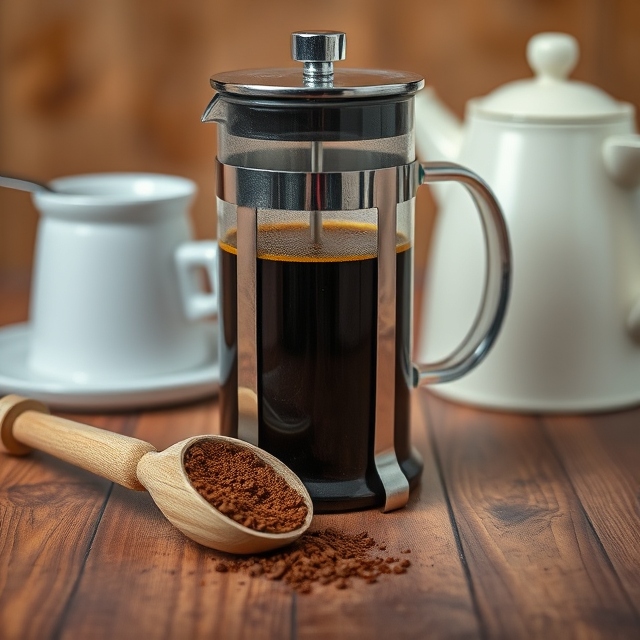
Yes, French press white coffee can be brewed successfully, although exceptionally light-roasted coffee may require a little experimentation. The French press uses immersion brewing, allowing coffee grounds to remain in contact with hot water before the filter separates the brewed drink from the grounds.
This method can be useful for unusually light coffee because the brewer has direct control over steeping time, grind size, water temperature, and coffee-to-water ratio. Those variables can be adjusted when the coffee does not extract as expected.
Why Use a French Press for White Coffee?
French press brewing differs from drip and espresso because it does not rely on water passing quickly through a compact coffee bed.
Instead, the grounds are immersed in water for a set period. This gives the water plenty of contact with the coffee, which can be useful when working with dense, lightly roasted beans.
The resulting drink can also have more body and texture than coffee brewed through a paper filter. Fine particles and some coffee oils remain in the finished cup, contributing to its mouthfeel.
Choosing a Grind for French Press White Coffee
A coarse grind is the traditional starting point for French press brewing. The particles should be large enough to remain relatively easy to separate with the plunger.
However, unusually light-roasted coffee can require some experimentation. If the grounds are too coarse for the particular beans and brewing conditions, extraction may be limited.
A slightly finer grind can increase the surface area available to the water. The trade-off is that very fine particles can make pressing more difficult and may leave more sediment in the cup.
The best approach is to begin with a sensible coarse setting and adjust gradually based on taste.
What Water Temperature Should You Use?
Water temperature is an important extraction variable.
Very light coffee can be relatively resistant to extraction compared with more developed roasts. Using sufficiently hot water can therefore be useful when preparing it in a French press.
Rather than focusing on one universal temperature, consider the complete brewing process. Temperature interacts with grind size and steeping time, so changing one variable can affect how the others perform.
If the finished coffee tastes sharp, thin, or incomplete, more effective extraction may be needed. If it tastes harsh or overly dry, reducing extraction may produce a better balance.
How Long Should White Coffee Steep?
Steeping time determines how long the water remains in contact with the coffee grounds.
A reasonable starting point is the normal French press brewing range recommended for your equipment, followed by adjustments based on flavor. If the coffee tastes under-extracted, a longer steep can be tested.
If the cup becomes overly strong, bitter, or dry, shortening the steeping time may help.
Consistency is important during experimentation. Keep the coffee dose, water amount, and grind unchanged while testing different steeping times. This makes it easier to identify what actually changes the cup.
Does White Coffee Need More Extraction?
Not necessarily, but very light-roasted coffee can present extraction challenges.
Roast development affects the physical structure of the bean, and exceptionally light beans can remain dense and hard. Once ground, their interaction with water may therefore differ from that of a darker roast.
The goal is not simply to extract more. Instead, aim for balanced extraction that brings out desirable characteristics without creating harshness.
A coffee that tastes sour or thin may need more extraction, while a dry or unpleasantly bitter cup may need less.
What Can You Expect From the Flavor?
French press brewing can emphasize body and mouthfeel because the paper-free filter allows more oils and fine particles into the cup.
The flavor of white coffee itself depends on the beans and roast style. Some exceptionally light coffees can show nutty, cereal-like, herbal, fruity, or other distinctive characteristics.
Because French press brewing produces a fuller texture, these characteristics can be experienced differently than they would through a paper-filtered pour-over or drip brewer.
For anyone exploring different preparation options, white coffee for French press provides a relevant reference point when considering how an unusually light coffee can fit into a French press routine.
A Simple French Press Method
A straightforward approach can make experimentation easier:
- Use a suitable coarse grind. Start with a consistent particle size.
- Measure the coffee and water. Keep the ratio consistent while testing.
- Add hot water. Make sure the grounds become evenly saturated.
- Allow the coffee to steep. Begin with your brewer’s normal brewing range.
- Press slowly. Apply steady pressure rather than forcing the plunger.
- Taste and adjust. Change only one variable during the next brew.
This process gives you a controlled way to learn how the coffee responds.
What If the Coffee Is Difficult to Grind?
One practical issue comes before brewing: getting the beans to the correct grind.
Exceptionally light-roasted beans can be harder and denser than more developed coffee. Some home grinders may struggle to produce a consistent coarse grind.
If your equipment handles the beans comfortably, whole-bean preparation gives you control over freshness and grind size. If the grinder struggles, a suitable pre-ground option can eliminate that problem.
For French press brewing, the important consideration is that the grounds are appropriately sized for immersion brewing rather than simply whether the coffee started as whole beans.
Is French Press a Good Choice?
French press brewing can be a useful method for exploring white coffee because it offers straightforward control over immersion time and grind size.
It does not require the precision of espresso preparation, yet it provides enough flexibility to adjust extraction when dense, lightly roasted coffee behaves differently from familiar beans.
Start with a coarse grind, suitable hot water, a consistent coffee-to-water ratio, and a reasonable steeping time. Then adjust gradually according to the flavor in the cup.
With a little experimentation, French press brewing can provide a simple way to experience the distinctive characteristics of exceptionally light-roasted coffee.