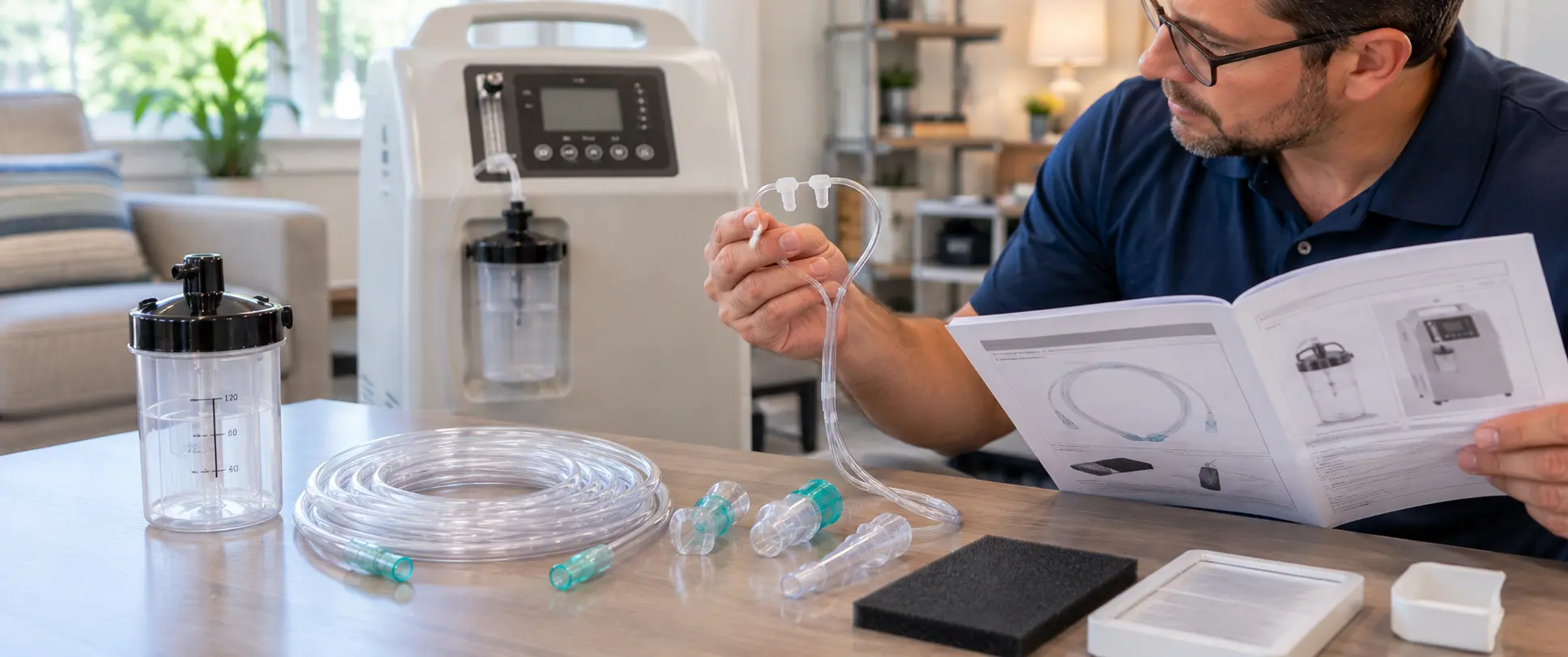
Oxygen concentrator accessories help deliver oxygen-enriched gas from a concentrator to a patient. Common examples include nasal cannulas, oxygen tubing, compatible connectors, and humidifier bottles.
Although these accessories may appear simple, their design and compatibility can affect the performance of an oxygen delivery system.
For example, excessively long tubing or an improper connection may interfere with the intended oxygen flow. Similarly, an unsuitable humidifier bottle can create problems if the concentrator manufacturer does not approve its use.
Understanding each accessory’s purpose helps patients and caregivers maintain a suitable oxygen delivery arrangement under professional medical guidance.
What Are the Main Oxygen Concentrator Accessories?
Different oxygen delivery systems require different components.
However, several accessories commonly support stationary home oxygen concentrators.
| Accessory | Main Purpose |
|---|---|
| Nasal cannula | Delivers oxygen through small prongs that rest inside the nostrils |
| Oxygen tubing | Connects the concentrator to the prescribed delivery interface |
| Tubing connector | Joins compatible tubing sections when the manufacturer permits |
| Humidifier bottle | Adds moisture to the oxygen stream when clinically appropriate |
| Oxygen mask | Provides an alternative delivery interface when the prescription requires one |
Not every accessory suits every concentrator or patient.
Therefore, equipment compatibility and the prescribed oxygen delivery method should guide selection.
Nasal Cannulas: How They Deliver Oxygen
A nasal cannula is a lightweight oxygen delivery device with two small prongs that rest inside the nostrils.
Flexible tubing connects the cannula to an oxygen source.
Patients commonly use nasal cannulas for low-flow oxygen therapy because these devices allow them to speak, eat, and perform many everyday activities while receiving prescribed oxygen.
Choosing a Suitable Nasal Cannula
Cannulas vary in size, tubing design, and intended use.
Important considerations include:
- Appropriate sizing for the patient.
- Compatibility with the prescribed oxygen flow.
- Comfortable positioning around the ears and face.
- Suitable materials for the patient’s needs.
- Manufacturer-recommended replacement procedures.
An incorrectly fitted cannula may cause discomfort or interfere with the intended oxygen delivery.
However, patients should not change the prescribed flow setting to compensate for an uncomfortable cannula.
Instead, they should consult their healthcare provider or equipment supplier.
Oxygen Tubing: Length, Connections, and Safety
Oxygen tubing carries oxygen-enriched gas from the concentrator to the patient interface.
Manufacturers typically use flexible medical-grade materials suitable for oxygen delivery.
The tubing must remain compatible with the concentrator and prescribed treatment arrangement.
Does Oxygen Tubing Length Matter?
Yes. Tubing length can affect resistance to gas flow.
Longer tubing arrangements may introduce additional pressure loss, particularly when users add connectors or create bends and restrictions.
Therefore, users should follow the maximum tubing length and configuration that the equipment manufacturer permits.
They should not assume that adding multiple extension tubes is always acceptable.
Preventing Kinks and Disconnections
Position tubing to avoid sharp bends, compression, and accidental disconnection.
In addition, loose tubing across walkways can create a tripping hazard.
Patients and caregivers should regularly check accessible connections according to the equipment instructions.
If tubing develops damage or no longer meets the equipment requirements, replace it with an approved alternative.
Matching Oxygen Concentrator Accessories to Your Equipment
Accessory selection should begin with the exact concentrator model rather than appearance alone.
For example, patients reviewing DeVilbiss 525KS home oxygen equipment can identify the stationary concentrator manufactured by Drive DeVilbiss Healthcare. They can then consult its operating manual for compatible oxygen delivery accessories.
The DeVilbiss 525KS provides continuous-flow oxygen delivery within its specified operating range.
However, this does not mean every commercially available cannula, tubing extension, or humidifier bottle will work safely with the machine.
Compatibility depends on the manufacturer’s instructions, accessory specifications, and the patient’s prescribed oxygen delivery arrangement.
Therefore, buyers should confirm uncertain accessory combinations with an authorized equipment supplier.
What Is an Oxygen Concentrator Humidifier Bottle?
An oxygen humidifier bottle adds moisture to oxygen-enriched gas as it passes through the accessory.
Healthcare professionals may recommend humidification for particular oxygen delivery arrangements.
However, not every patient or flow setting requires humidification.
How Does a Humidifier Bottle Work?
A compatible humidifier bottle connects to the concentrator’s oxygen outlet through the appropriate fitting.
Oxygen passes through the bottle’s humidification system before traveling through the delivery tubing.
Users must install and fill the bottle according to its instructions.
Never substitute an ordinary household container for a medical oxygen humidifier.
What Water Should You Use?
Water requirements depend on the humidifier manufacturer’s instructions and the healthcare provider’s recommendations.
Some systems specify distilled water or another approved water type.
In addition, users must observe the bottle’s fill markings and cleaning requirements.
Incorrect filling or maintenance can create hygiene and equipment problems.
Therefore, always follow the instructions for the exact humidifier model.
How Often Should Oxygen Accessories Be Replaced?
No universal replacement schedule applies to every oxygen accessory.
Replacement intervals depend on the product, manufacturer, usage conditions, and clinical guidance.
For example, nasal cannulas may require replacement because of wear, contamination, or damage.
Similarly, caregivers should inspect oxygen tubing for visible deterioration, obstruction, or insecure connections.
Humidifier bottles also require cleaning and replacement according to their specific instructions.
Patients should avoid continuing to use damaged accessories simply because they appear functional.
Signs That an Accessory May Need Replacement
Common signs include:
- Cracked or damaged oxygen tubing.
- Loose or unreliable tubing connections.
- Visible contamination that cleaning cannot safely address.
- Damaged nasal cannula prongs.
- Deterioration of humidifier bottle components.
If an accessory shows these problems, consult the manufacturer’s instructions or equipment provider before replacing it.
Common Oxygen Concentrator Accessory Mistakes
Several mistakes can affect the safety or suitability of an oxygen delivery arrangement.
- Using incompatible connectors: An unsuitable fitting may create leaks or unreliable connections.
- Adding excessive tubing: Unapproved tubing lengths may affect oxygen delivery.
- Ignoring humidifier instructions: Incorrect water levels or cleaning procedures can create problems.
- Reusing disposable components beyond their intended use: This may increase hygiene concerns.
- Applying oils or petroleum-based products near oxygen equipment: These products may increase fire hazards in oxygen-enriched environments.
Because oxygen supports combustion, patients and caregivers must also keep smoking materials and open flames away from oxygen equipment and accessories.
The U.S. Food and Drug Administration’s guidance on home oxygen therapy provides further information about oxygen equipment safety and appropriate medical supervision.
Following these precautions helps reduce avoidable risks during home oxygen therapy.
Can You Use the Same Accessories With Different Concentrators?
Some accessories may work with multiple concentrator models.
However, users should never assume compatibility simply because connectors appear similar.
Different devices may have distinct outlet fittings, pressure characteristics, or manufacturer restrictions.
Before transferring accessories between machines, verify their suitability using the relevant equipment instructions.
This becomes especially important when changing between stationary and portable oxygen systems.
For example, an accessory that works with one continuous-flow concentrator may not suit a different oxygen delivery arrangement.
Therefore, patients should confirm compatibility before making changes.
How to Maintain Oxygen Concentrator Accessories Safely
Proper accessory care supports hygiene and dependable oxygen delivery.
Patients and caregivers should follow the cleaning, inspection, and replacement instructions for each component.
For example, some reusable accessories allow specific cleaning procedures, while disposable components require replacement rather than repeated cleaning.
In addition, users should keep tubing connections secure and check for visible damage during routine equipment inspections.
However, cleaning methods that suit one accessory may damage another.
Avoid applying household disinfectants or cleaning chemicals unless the manufacturer specifically approves them.
If an accessory becomes damaged or unsuitable, contact the equipment supplier for an appropriate replacement.
Final Thoughts on Oxygen Concentrator Accessories
The right accessories help connect medical oxygen equipment to the patient’s prescribed delivery interface.
Nasal cannulas provide a common oxygen delivery method, while tubing and compatible connectors carry oxygen from the concentrator. Humidifier bottles may provide additional moisture when clinically appropriate.
However, correct compatibility, proper installation, and manufacturer-recommended maintenance remain essential.
By selecting suitable accessories and following professional guidance, patients and caregivers can support a safer and more dependable home oxygen delivery arrangement.