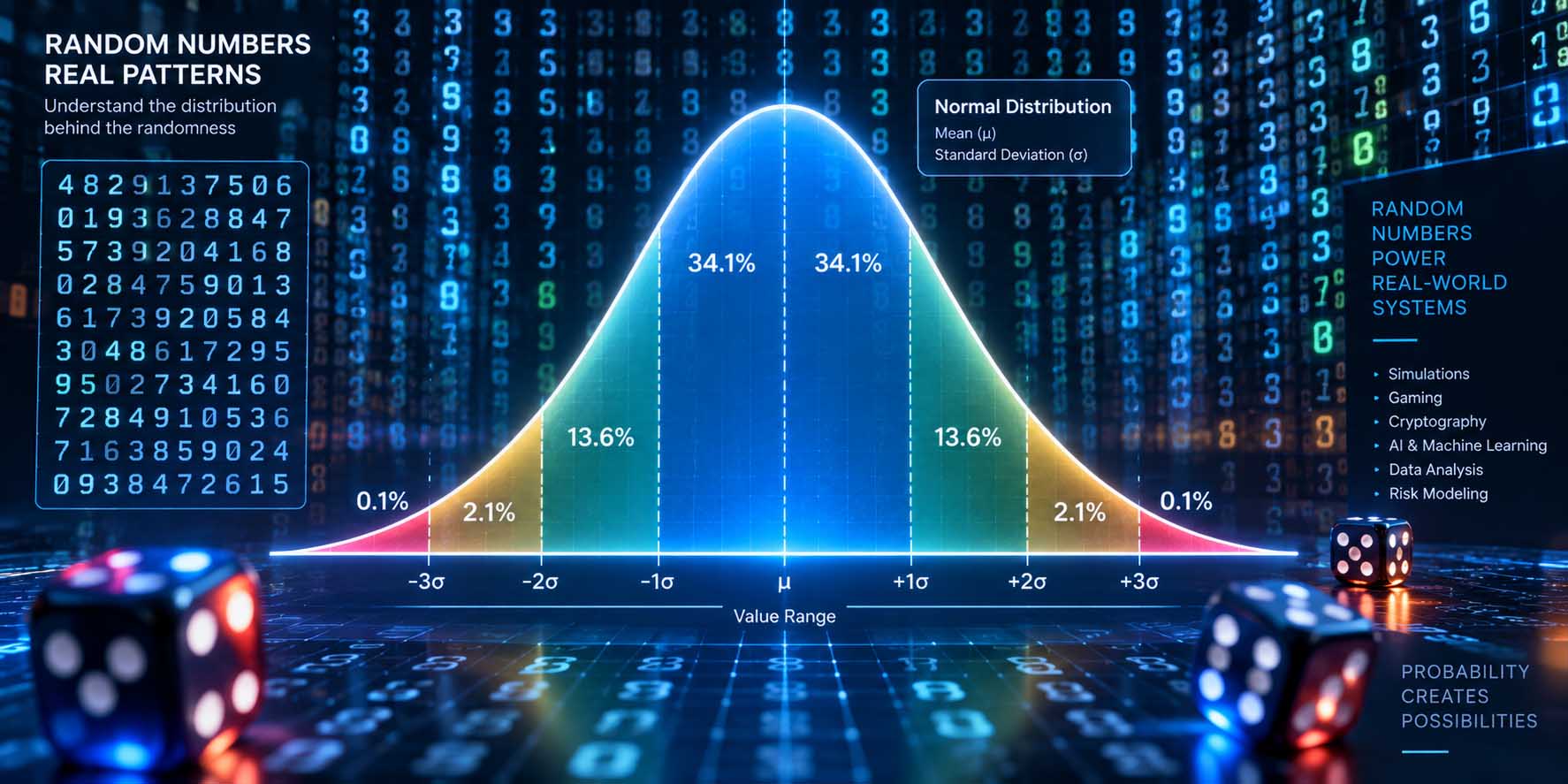
In both theoretical mathematics and modern computational design, understanding how unpredictability is modeled and measured remains a core engineering challenge. While true randomness exists in fundamental quantum mechanics, digital computers operate on deterministic logic gates, requiring specialized algorithms to simulate uncertainty. The science of random outcomes provides the theoretical foundation for how software systems generate, test, and apply randomized sequences across various applications.
Understanding how random number generators function, how probability distributions are evaluated, and what mathematical principles govern stochastic models allows developers and data scientists to build robust, fair simulation environments.
Deterministic Systems and Pseudo-Randomness
Computers are inherently deterministic machines; given the same initial instructions and input parameters, they will always produce the exact same output. Because true physical randomness (such as atmospheric noise or radioactive decay) is difficult to capture at scale for high-speed web workloads, software systems rely on Pseudo-Random Number Generators (PRNGs).
A PRNG uses a mathematical formula—seeded by an initial starting value—to generate long sequences of numbers that approximate statistical randomness. While the sequence is entirely reproducible if the seed is known, modern cryptographic algorithms ensure that the generated output appears completely unpredictable to external observers.
Hardware-Based Randomness and Entropy
To overcome the limitations of algorithmic PRNGs, high-security applications and cryptographic systems utilize Hardware Random Number Generators (HRNGs). These systems harvest entropy from physical phenomena, such as thermal noise within semiconductor junctions, clock jitter, or quantum fluctuations.
Collecting physical entropy ensures that generated outcomes cannot be reverse-engineered or predicted, providing an unbreakable foundation for cryptographic keys, secure session tokens, and cryptographic protocols.
Evaluating Statistical Distribution and Fairness
Generating random outcomes is only part of the equation; verifying that a sequence of outcomes is uniformly distributed and unbiased requires rigorous statistical testing. Analysts use standardized test suites—such as the NIST statistical test suite—to evaluate frequency distribution, serial correlation, and pattern independence across millions of generated data points.
When examining how complex digital platforms structure interactive simulations and secure random processing models, analyzing platforms such as TOK99TOTO illustrates how dedicated interactive infrastructure utilizes validated computational pipelines to manage data flows. While specific algorithms, seeding methods, and performance optimizations vary across individual environments, maintaining rigorous mathematical fairness remains a universal priority.
Common Questions About Random Outcomes
What is the difference between a PRNG and a TRNG?
A Pseudo-Random Number Generator (PRNG) uses mathematical formulas to calculate reproducible sequences, whereas a True Random Number Generator (TRNG) derives entropy from physical, unpredictable real-world sources.
Can a pseudo-random sequence ever repeat?
Yes. Because PRNGs operate on finite mathematical states, every algorithm will eventually loop back to its initial seed value and repeat the identical sequence of numbers after an extended period.
Why is predictability a risk in software design?
If an attacker can predict the output of a random number generator (such as session token creation or password reset tokens), they can hijack user accounts or bypass security authentication barriers.
Conclusion
The science of random outcomes bridges theoretical probability with practical software engineering. By understanding how pseudo-random algorithms, hardware entropy sources, and rigorous statistical tests operate, developers can design secure, fair, and reliable systems capable of handling complex computational uncertainty.